
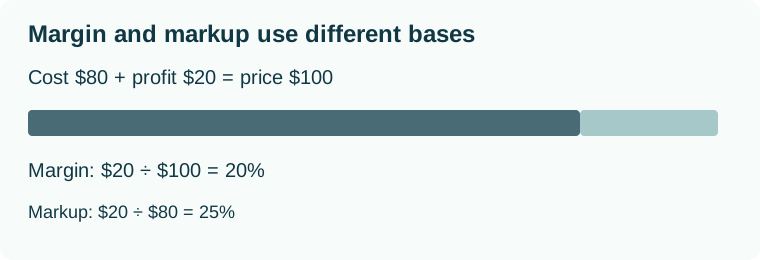
Margin divides profit by selling price. Markup divides profit by cost. They describe the same difference between price and cost using different denominators.
For this explanation, “profit” means selling price minus the particular costs entered. It is not automatically net profit. Use consistent tax treatment and a positive cost and price for the conversion formulas below.
Follow one sale
A product costs 80 and sells for 100. The difference is 20.
- Markup: 20 ÷ 80 × 100 = 25%.
- Margin: 20 ÷ 100 × 100 = 20%.
Changing the label without changing the formula creates a pricing error. A target of 25% margin on an 80 cost requires 80 ÷ 0.75 = 106.67, not 100.
Convert between the percentages
Using decimal rates:
Margin = markup ÷ (1 + markup)
Markup = margin ÷ (1 − margin)
| Markup on cost | Corresponding margin on price |
|---|---|
| 10% | 9.09% |
| 25% | 20% |
| 50% | 33.33% |
| 100% | 50% |
These are arithmetic relationships, not recommended targets. With a positive cost, a finite price cannot achieve 100% margin under this simple formula. A 100% markup is possible: it doubles the cost to obtain the price.
Choose the right input convention
Use the markup calculator when the instruction is “add this percentage to cost.” Use the profit margin calculator when you already know revenue and cost and want the proportion retained.
If you are setting a service quote to a margin target, first identify the complete cost base in the service pricing guide. A correct formula with missing labour or overhead still produces an incomplete estimate.
What happens when the cost changes?
Keep the selling price at 100 but raise cost from 80 to 88. The retained amount falls to 12. Margin becomes 12%; markup becomes 13.64%. Neither remains at its original percentage.
To restore a 20% margin, the new price is 88 ÷ 0.80 = 110. That result assumes the same included costs and no percentage-of-price fee.
Check before comparing two margins
Ask whether both calculations include the same expenses. One seller may use purchase cost alone while another includes shipping, handling and labour. The percentages cannot be compared meaningfully until the cost definitions match.
Business Queensland distinguishes pricing based on costs from other pricing approaches. Our conversion table above is independently constructed arithmetic, not an industry benchmark. Pricing reference.
About the examples and sources
The figures are hypothetical teaching examples created for AskToBot, not surveyed prices or recommended industry margins. The linked references explain the underlying concepts; they do not supply or endorse these example figures. The arithmetic is checked against the stated assumptions. This is AI-assisted educational content and has not been independently reviewed by an accountant. Read how we check calculations.
Sources & references
- Pricing products and services — Business Queensland